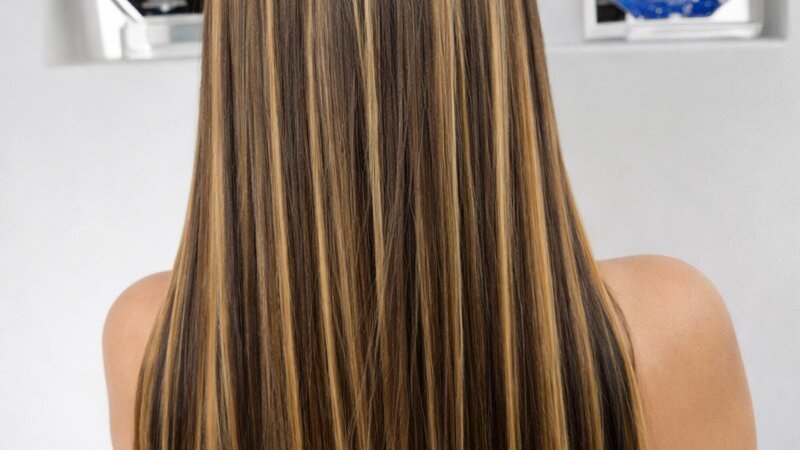
Yes, Japanese hair straightening can often be limited to newly grown hair when previously treated lengths remain straight and in suitable condition. A regrowth-focused appointment requires professional evaluation to identify untreated hair, avoid unnecessary chemical overlap, and determine whether the new growth can safely undergo another straightening procedure.
For clients in Scottsdale, AZ, who have previously received permanent straightening, natural waves or curls may gradually become visible near the roots. Understanding how these sections differ from chemically straightened lengths helps explain why maintenance appointments require a different approach from an initial treatment.
Why Does New Hair Growth Have a Different Texture?
Japanese straightening changes the structure of treated hair, creating a permanently straighter appearance along the processed sections.
However, the treatment does not change how new hair grows from the follicle.
As untreated hair emerges, it generally retains the person’s natural curl or wave pattern. This creates a visible transition between textured roots and previously straightened lengths.
Natural Regrowth Versus Treated Hair
Consider someone with naturally wavy hair who received Japanese straightening several months earlier.
The existing lengths may remain smooth while new growth develops its original wave pattern.
This difference does not necessarily indicate that the previous treatment has stopped working.
Instead, it reflects the distinction between untreated growth and permanently processed hair.
A professional evaluates whether the existing straightened sections remain satisfactory before recommending additional treatment.
Why the Transition Becomes Noticeable
The visibility of regrowth depends on natural texture, hair length, and the amount of new growth.
Someone with loose waves may experience a relatively subtle transition.
A client with tighter curls may notice greater contrast between the roots and straightened lengths.
These differences influence when a maintenance consultation becomes appropriate.
How Does Regrowth-Focused Japanese Straightening Work?
A regrowth appointment concentrates on untreated hair rather than automatically repeating the entire original service.
Traditional Japanese thermal straightening involves chemical restructuring, controlled heat, and neutralization.
During maintenance, the professional must determine which sections require treatment and which should remain protected from unnecessary processing.
The appropriate approach depends on the selected product system and its manufacturer instructions.
Identifying Untreated Hair
The stylist evaluates where natural texture begins and where previously straightened hair remains.
This transition can be easier to identify when regrowth has a noticeably different curl pattern.
However, boundaries may become less obvious when natural hair is only slightly wavy or when earlier results vary across sections.
A careful assessment helps distinguish untreated growth from areas that have already undergone chemical restructuring.
Evaluating the Existing Lengths
Previously straightened hair may remain smooth but still require assessment.
Its structural condition can be influenced by subsequent coloring, heat exposure, and mechanical wear.
The stylist considers whether those sections are suitable for the proposed maintenance procedure.
A regrowth-focused appointment should not assume that previously treated hair can safely tolerate another complete application.
Why Is Avoiding Chemical Overlap Important?
Chemical overlap occurs when a new straightening application extends onto hair that has already undergone the same or another restructuring treatment.
This matters because previously processed sections may have reduced tolerance for additional chemical exposure.
Repeated processing can increase the risk of weakening or breakage.
How Overlap Can Affect Hair Strength
Japanese straightening systems alter chemical bonds that contribute to the hair’s structure.
Once a section has been treated, repeating the process unnecessarily may place additional stress on its existing bonds.
The resulting damage can vary depending on previous processing, product formulation, and hair condition.
Professional application aims to limit unnecessary exposure while following the manufacturer’s technical requirements.
Why the Boundary Requires Careful Assessment
The transition between untreated and processed hair may contain sections with different structural characteristics.
Natural growth has not undergone the earlier straightening procedure, while neighboring lengths have.
This difference makes precise treatment planning important.
The stylist must account for where chemical products can be applied appropriately and whether the existing hair can support another service.
Simply applying the original procedure to the entire head may be unsuitable.
When Is a Regrowth Appointment Appropriate?
A maintenance appointment may be considered when enough untreated hair has grown to allow the professional to evaluate and work with the new section appropriately.
However, no universal regrowth length or appointment interval applies to everyone.
Natural growth rate, curl pattern, hair condition, and product requirements influence the decision.
How Natural Texture Influences Timing
Clients with tightly curled hair may notice the difference between treated and untreated sections sooner than those with loose waves.
A more visible transition does not automatically mean immediate chemical processing is appropriate.
The stylist must still determine whether sufficient regrowth is available for the intended system.
Why Appointment Timing Varies
Some clients maintain their results through periodic professional touch-ups, while others prefer longer intervals.
The appropriate schedule depends on individual characteristics rather than a fixed calendar.
Clients considering a japanese hair straightening treatment should discuss maintenance expectations with a qualified professional before scheduling another chemical service.
The objective is to determine when the procedure is appropriate, not simply when regrowth becomes noticeable.
How Does Previous Coloring Influence Regrowth Treatment?
Hair coloring can affect whether newly grown sections are suitable for permanent straightening.
A client may have natural roots, previously colored midlengths, and chemically straightened ends.
These sections can respond differently to additional processing.
Color-Treated Regrowth
Permanent coloring and lightening can influence hair structure and chemical compatibility.
If the regrowth has undergone coloring since the previous straightening appointment, the stylist must consider that history.
Certain straightening systems restrict application to significantly lightened or damaged hair.
A professional evaluation helps determine whether the proposed service meets those requirements.
Previously Highlighted Lengths
Even when the appointment focuses on untreated growth, previously highlighted lengths deserve consideration.
Their condition may influence how the stylist manages the boundary between treated and untreated sections.
Additional chemical exposure may be inappropriate when existing hair has substantial processing damage.
A maintenance plan should therefore account for the entire hairstyle.
Can Every Japanese Straightening System Treat Regrowth?
Not every system has identical product requirements or application instructions.
Although Japanese permanent straightening methods share the goal of altering hair texture, their formulations and professional procedures can differ.
The suitability of a regrowth-focused application depends on the specific system being used.
Understanding Yuko Straightening
Yuko is an established Japanese thermal straightening system designed to create a permanently straighter hair texture.
Its manufacturer recognizes that touch-up applications can generally focus on newly grown hair, subject to hair condition and treatment suitability.
Clients researching japanese hair straightening yuko should understand that regrowth treatment requires the same attention to compatibility and professional assessment as an initial application.
A previous successful appointment does not automatically guarantee eligibility for another.
Why Product Instructions Matter
Different systems may specify particular procedures for previously treated hair.
A professional should follow the applicable manufacturer’s directions rather than assume that techniques from one system are interchangeable with another.
This consideration becomes especially important when clients have changed salons or cannot identify the products previously used.
What Should a Professional Straightening Consultation Evaluate?
A regrowth consultation examines more than the amount of newly grown hair.
The stylist reviews previous treatment history, natural texture, current hair condition, and desired appearance.
This information helps determine whether a limited application is suitable.
Previous Straightening History
Knowing which system was previously applied helps the stylist understand potential compatibility concerns.
The date of treatment and any subsequent chemical services may also be relevant.
Clients who received straightening elsewhere may need additional assessment when previous product information is unavailable.
Hair Condition and Breakage
Hair that appears smooth is not necessarily free from structural damage.
A professional evaluates visible breakage, elasticity, and differences between treated sections.
If significant weakness is present, another chemical procedure may be inappropriate.
Strand testing may provide additional information when permitted by the manufacturer’s instructions, although it cannot eliminate every processing risk.
Desired Finished Appearance
Some clients want the new growth to match their existing straightened lengths as closely as possible.
Others may have changed their styling preferences since the initial appointment.
A consultation helps clarify whether permanent regrowth straightening remains consistent with their goals.
Maintaining Straightened Hair as New Growth Appears
Japanese straightening can often be limited to newly grown hair when the existing lengths remain adequately straight and suitable for continued maintenance.
However, identifying the treatment boundary, avoiding unnecessary overlap, and evaluating previous chemical services are essential considerations.
A regrowth appointment should be recommended only after assessing the natural hair, existing processed sections, and requirements of the selected straightening system.
Professional consultation helps clients understand their available options without assuming that every maintenance appointment requires full-length chemical processing.
About Bravo Salon
Bravo Salon offers Japanese thermal straightening, Yuko treatments, hair coloring, and related salon services at 10614 N 71st Place in Scottsdale, Arizona. Their owner and creative director, Alicia Shannon Bravo, is identified by the salon as a certified Japanese Liscio and Yuko straightening specialist. For appointment inquiries, call (480) 951-8076 or find their Scottsdale salon on Google Maps.